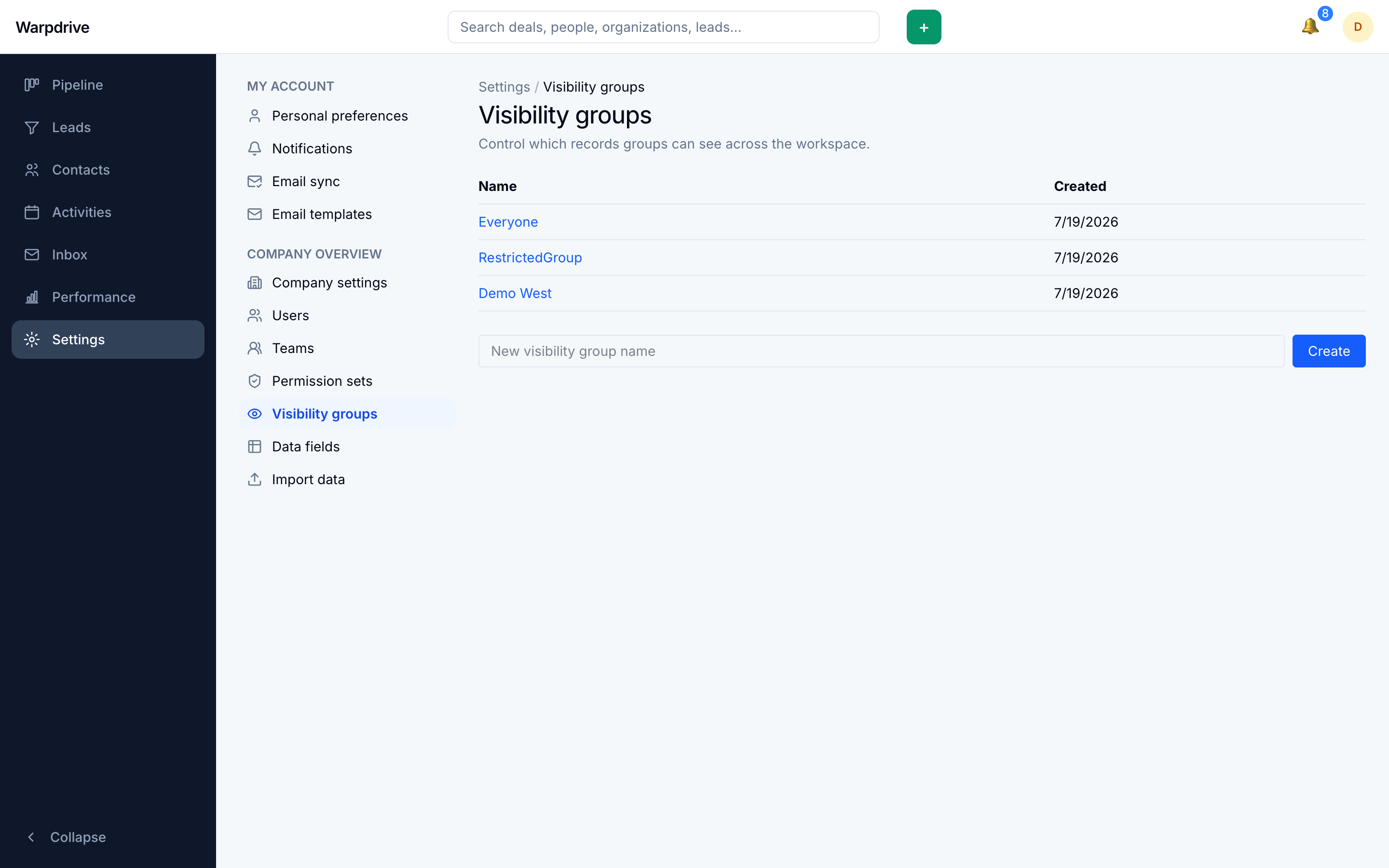
Visibility groups
Visibility decides which records exist as far as a given user is concerned. It is evaluated before any permission, and permissions never widen it.
/settings/visibility-groups manages groups. An Everyone group is seeded on first
run, and every new or invited user joins it as their primary group.
How visibility is decided
For a given record and user, visibility can come from any of:
- an explicit grant to that user,
- ownership of the record,
- ownership by a member of a team the user manages,
- the record being marked visible to all, or
- the record's visibility group matching one of the user's groups.
Any one of these is sufficient.
Restricted pipelines come first
A restricted pipeline is a hard gate for non-administrators, evaluated before everything above.
If a user cannot see the pipeline, they cannot see its deals, and that holds even if they own a deal in it or were granted it explicitly. Restricting a pipeline is therefore the strongest control available, and also the easiest way to accidentally hide someone's own deals from them.
Visibility and aggregates
Counts and totals are computed with the same visibility rule as the rows, so invisible records do not contribute to stage totals, list footers, or dashboard figures.
Two people can legitimately see different totals for the same pipeline. That is the model working, not a reporting bug.
Entities and activities
Visibility for records and for activities is evaluated by separate rules. Restricting a record does not automatically restrict every activity referencing it.
When configuring restricted access, verify the result by signing in as an account that holds the restricted configuration and checking each surface. This distinction between entity and activity scoping has been a repeated source of mistakes, and it is not visible from the configuration screen.